A rose, animal portrait or dagger can look very different depending on how it is drawn. If your saved tattoo references include bold outlines, strong shapes and decorative details, you may be comparing traditional and neo-traditional work without knowing which label to use.
You do not need to learn a style dictionary before enquiring. This guide explains the practical differences, so you can describe the tattoo you want when contacting The Viper Pit in Irlam.
What does traditional tattooing look like?
In this comparison, “traditional” means Western or American traditional tattooing, often called old school. The word also describes other established tattoo traditions, so showing references avoids confusion.
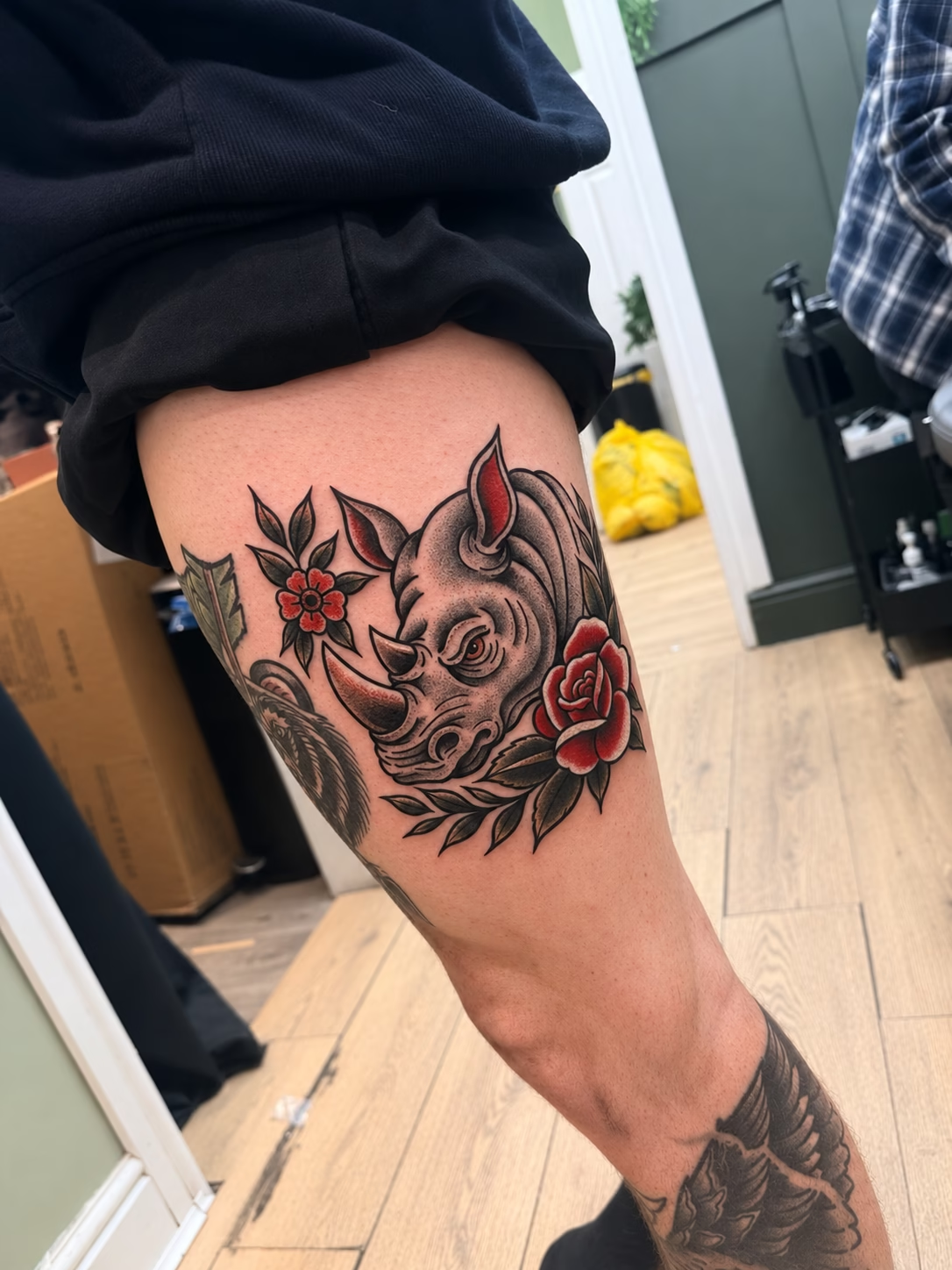
American traditional work usually relies on a clear outline, simplified shapes, deliberate black shading and a relatively limited colour palette. Familiar subjects include roses, swallows, hearts, ships, daggers and eagles. The image is designed to read clearly without needing lots of tiny surface details.
Explore our traditional tattoo page if this is the direction you have in mind. You can request a personal subject in a traditional treatment; choosing the style does not mean you must pick a familiar symbol.
What changes in neo-traditional work?
Neo-traditional tattoos build on the use of strong outlines and readable shapes, but often allow more variation in line weight, colour, shading and ornament. You may see more elaborate flowers, expressive animals, decorative frames or a greater sense of depth.
These are broad tendencies rather than fixed rules. One artist’s work may sit close to traditional tattooing; another may lean towards illustration. A style label helps start the conversation, but the actual portfolio tells you much more.
Compare the treatment of the same subject
Instead of comparing a small traditional heart with a large neo-traditional animal, look at how the same subject could be drawn:
- A rose: a compact arrangement of simplified petals, or a more layered flower with additional curves and tonal detail.
- An animal: a bold, stylised head, or a more expressive illustration with selected fur, folds and decorative elements.
- A dagger: a straightforward blade and handle, or a more elaborate composition with framing and a wider range of textures.
Neither approach is automatically better. Decide what you want to notice first: the silhouette, the expression, the colour or a particular detail. That gives the artist a useful starting point for the composition.
Does neo-traditional have to be in colour?
No. Colour is common in both styles, but black-and-grey versions are possible. Removing colour does not, by itself, turn a design into realism or blackwork. The outline, shape, shading and overall drawing still determine how it reads.
If you like a coloured reference but want a black-and-grey tattoo, say so at the enquiry stage. The artist may need to rethink the contrast rather than simply remove the colour. Our blackwork and black-and-grey guide explains those separate terms.
Let the available space guide the detail
A highly decorated design may need more room than a simpler version of the same subject. Send an approximate height and width in centimetres and identify the exact placement. “Upper outer arm” gives a clearer starting point than “arm”.
If the tattoo will sit beside existing work, include a photograph of the whole area. Think about the space around the tattoo as well as the drawing itself. For a future sleeve, mention that plan before committing to a standalone piece.
Flash or a custom design?
Either style can appear as flash or custom work. Flash describes an existing design offered by an artist; custom work is developed around your brief. It does not tell you whether the tattoo will be traditional or neo-traditional.
Our flash and custom tattoo guide explains the booking difference. Use another artist’s tattoo to show the direction you like, then discuss an original design rather than requesting an exact copy.
Send a useful tattoo enquiry
Choose a few references and explain what you like about each. For example: “I like this strong outline and animal expression, but want fewer flowers and black-and-grey shading.” Include your placement, approximate size, budget and preferred dates. Ask the studio to recommend an artist whose work suits the idea.
A style name alone cannot determine the price or session length. For a detailed composition, our tattoo consultation guide explains how to start the discussion.
The Viper Pit Tattoo & Piercing Studio is at 84 Liverpool Road, Irlam, Salford, M44 6FN. We welcome enquiries from Eccles, Urmston, the Trafford Centre area and across Greater Manchester.
Send us your tattoo idea and references. Tell us which parts of the artwork matter to you, and we will discuss the design and appropriate booking options.